
DID YOU KNOW?
Founded in 1236, Šiauliai (pronounced Show-lay) is a historic city in northern Lithuania, one of the three Baltic States of Northern Europe. It is located at the junction of two roads used by hunters, warriors and merchants in times much older than the city itself and near the geographic center of Europe. These roads now connect Talinn and Warsaw, and run west to the seaport of Klaipeda and east to Russia through Latvia. Its strategic location has made it an important regional center throughout history, and the city has experienced periods of changing political control over the centuries.
Known as the City of the Sun, Šiauliai is surrounded by a predominantly flat landscape shaped by gentle, rolling hills, expansive agricultural fields, and patches of pine and deciduous forests. The surrounding countryside reflects Lithuania’s agricultural heritage, with wheat, rye, oats, barley, and peas among the principal crops grown in the region.
One of the area’s most significant landmarks is the Hill of Crosses, located approximately 12 kilometers north of Šiauliai. This remarkable pilgrimage site and national monument is distinguished by its thousands of crosses, symbolizing faith, resilience, and national identity. It stands as a powerful expression of Lithuania’s cultural and spiritual heritage.
POPULATION
Šiauliai’s population is approximately 110,000.
LOCATION
Šiauliai is an important transit and commercial hub. The city is located on the Berlin-Kaliningrad-St. Petersburg highway (Via Baltica). Šiauliai is also connected by direct rail to the sea with five ice-free Baltic sea ports (Kaliningrad, Klaipėda, Liepaja, Ventspils, and Riga) nearby. The largest former military airbase in Eastern Europe is also located in Šiauliai; this airport is large enough for a space shuttle to land there. Šiauliai is some 117 miles (188 kilometers) from Vilnius – the Lithuanian capital, and 76 miles (123 kilometers) from Riga – the Latvian capital.
The city covers 81.1 square kilometers. Lithuania is bordered by Latvia to the North, Belarus to the East and South, Poland to the South, and the Baltic Sea and Russia (the Kaliningrad Oblast) to the West.

HISTORY
Šiauliai is Lithuania’s fourth largest city, both in area and inhabitants, and is informally referred to as the capital of northern Lithuania. Despite its contemporary appearance, Šiauliai is also one of Lithuania’s oldest cities, first mentioned in historical documents in 1524. An important milestone in its history is ‘Saulės Mūšis’ (the Battle of the Sun) in 1236, in which Lithuanian forces decisively defeated an invasion by the Livonian Order from Latvian territory. The city’s fate has been much influenced by its geographic situation and location. On one hand its situation makes it a natural transportation hub. For example, the Zokniai airfield on the outskirts of Šiauliai, which became the largest military airbase in the former Soviet Union, now serves as a Lithuanian military and NATO airbase, as well as a major air cargo hub. Conversely, ideal central location has placed Šiauliai at crossroads of military campaigns throughout its history. Indeed, most of the old city’s architectural treasures were destroyed during World War II air bombing campaigns.
EXCHANGES
Since 1996 on-going exchanges have been initiated between Šiauliai University students and both the University of Nebraska at Omaha and Creighton University. These exchanges involve both students and faculty, as well as musical, choral and folk dance ensembles.
Meet the Mayor
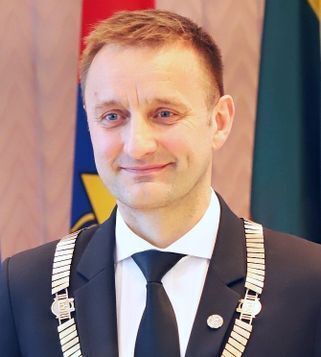
Mayor Artūras Visockas – Šiauliai, Lithuania
Artūras Visockas has served as the Mayor of Šiauliai since 2015, securing re-elections in 2019 and 2023. An independent politician, he leads the non-partisan civic list “Dirbame miestui” (“Working for the City”). Born on January 19, 1968, in Kelmė, Lithuania, Visockas graduated from Šiauliai 10th Secondary School and earned a degree in pedagogy from Šiauliai Pedagogical Institute in 1993. Prior to his political career, he operated a photography business, and was actively involved in community initiatives, including environmental clean-up projects around Salduvė Mound and Talkša Lake .
As mayor, Visockas emphasizes sustainable urban development, cultural heritage preservation, and international collaboration. Notably, he has initiated projects like the commemoration of Righteous Gentiles in Šiauliai and the relocation of Soviet soldiers’ remains in accordance with national legislation.
Mayor Visockas is married and has two sons.
TOP BUSINESSES
D. BECONIO IĮ - Construction firm produces wide range of timber products
AB “NEAUSTINIŲ MEDŽIAGŲ FABRIKAS” - Mattresses, upholstered furniture, plastic injection moulded products, home
UAB SALDA - European leader in production of ventilation equipment, heat pumps, heaters and coolers, controllers
BIGSO, UAB - Swedish capital company producing products of paper laminate, laminated canvas, recycled
ROL/STATGA AND ERGO - Leader of Baltic metal pipe processing services and special-purpose furniture
UAB “PUTOKŠNIS” - Leading manufacturer of PET pre-forms and PET bottles
RŪTA, UAB - Product with fillings including: nuts, caramels, truffles, dragée, creams, fruits, jellies
AB GUBERNIJA - Brewery/beer
BALTIK VAIRAS LITHUANIA - Largest bicycle & e-bikes manufacturer in Northern Europe
JSC “KALVIS” - Metal processing, custom industrial equipment, metal products processing

